How to play
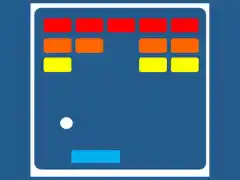
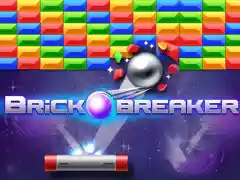
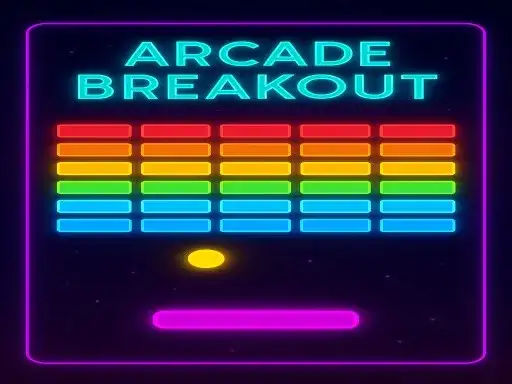
Arcade Breakout is a brick breaker. A paddle sits at the bottom of the screen, a ball bounces above it, and rows of bricks wait to be hit. You move the paddle to keep the ball in play, and every brick you touch disappears. Miss the ball and you lose a life. The developer describes the game as a modern take on the classic, with neon colors, a high-tech paddle, and a ball that looks like it is blazing.
Early on the ball drifts slowly enough that you can plan two or three bounces ahead, and later each contact makes the next return a little harder to read. The developer states that the ball gains speed with every hit, so reflex and anticipation matter as much as aim. Clear the screen and the next stage begins.
Bricks are arranged in rows, and the gaps between them become your routes. Hitting a brick on the outer edge sends the ball away at a new angle, which is useful when you want to reach a corner the paddle cannot see. The aim is simple, destroy the layout, keep the ball alive, and build the highest score you can.
Controls
Three input options are listed by the developer.
Mouse. Move the mouse horizontally across the screen and the paddle follows. The paddle tracks the pointer position across the screen, so a slow deliberate drag works as well as a fast one.
Touch. On phones and tablets, swipe or drag a finger horizontally across the screen. Keep the finger on the glass while you steer, because the paddle stops the moment the input stops.
Keyboard. The developer lists keyboard input for the paddle as an alternative. It suits players who prefer keys, and it needs no pointing device.
Whatever input you choose, movement is horizontal only and the paddle stays inside the bottom band of the play area for the whole run. The paddle cannot be tilted. Because it is a flat surface, your position at the moment of contact decides the return angle. Learn that and control becomes a skill you build over a few runs.
Levels and power-ups
The developer states that each new stage brings denser brick layouts and that the layouts are twice as big as before, so the wall you break grows as you progress. More bricks means more contacts, and more contacts means a faster ball. Difficulty comes from those two things stacking; no timer runs down.
The stated reward is the extra life. The developer says you earn extra lives by hitting multiple bricks in a way that counts as skilful, which favors a run where the ball travels far between paddle contacts. A long journey through the wall is worth more than a safe, short rally.
Beyond that, the developer names no other pickups, so treat each stage as a plain brick-clearing problem. Your resources are the ball, the paddle, and whatever lives you have left. Spend the ball well.
Tips and strategy
Keep the paddle near the middle by default. From the centre you can reach either side of the screen in the same amount of time, and the ball rarely arrives somewhere you cannot answer. Drifting to one edge because the ball went there leaves the other edge exposed on the return.
Aim with the paddle edge. Contact near a corner of the paddle pushes the ball out at a sharper angle, while contact with the middle sends it back almost straight. That difference is how you steer without a second control.
Think about the last row. Bricks near the top are safe to break early, but the low rows are the ones that decide how long the ball stays in play. As the ball speeds up, protect your margin for error. Slow hands beat fast, panicked ones.
Clear one side before the other. A habit of breaking bricks from a single edge inward keeps a clean lane open, so you always have somewhere predictable for the ball to travel. Treat it as a habit that cuts down surprise angles.
Watch the ball. Your hand follows naturally when your eyes stay on it, and the paddle is easier to move than to watch. Plan one bounce ahead at low speed and two when the ball is quick.
Take the extra life when it is offered. The developer ties extra lives to multi-brick hits, so a shot that travels through several bricks is worth more than a careful single. If a lane is open, use it.
Pause between stages. Each new layout is denser than the last, and starting a stage while still thinking about the previous one costs lives.
About this kind of game
Brick breakers go back to the arcade era, where a paddle, a ball and a wall of colored blocks were enough to fill a cabinet. The loop has barely changed. You defend the bottom of the screen, the ball does the work, and the score climbs as the wall shrinks.
A ball is a simple object, but its angle changes with every surface it touches, and the paddle adds a second variable, where you meet it. Small differences in position produce large differences in outcome. Players learn to read a bounce before it happens, and that reading skill outlasts any single level.
Risk is the other half. A fast ball clears bricks quickly and also ends runs quickly. Games in this family reward patience as much as reaction, because the score you are chasing is usually your own. There is no story to finish and no route to memorise beyond the layout in front of you.
Where and how to play
Arcade Breakout runs free in your browser on desktop and mobile. There is no download and no account. Open the page, press Play, and the game loads; nothing streams in the background before that.
If an ad appears, the provider’s player serves it. This page places none of its own. The game itself is the same either way.
A mouse suits a desktop or laptop. Phone and tablet play works through swipe and drag, so the whole game fits in one hand and one screen. Keyboard control is there for players who prefer it. Sessions are short by design, which makes it easy to fit a run or two into a spare few minutes and just as easy to start another.
FAQ
Do I need to install anything? No. The game runs in the browser on desktop and mobile, with no download and no account.
How do I move the paddle? Move the mouse horizontally on desktop, swipe or drag a finger horizontally on touch screens, or use the keyboard option.
What makes the ball faster? The developer states that the ball speeds up with each hit, which means more bricks broken and less time to react to the next return.
How do I get extra lives? The developer says extra lives come from hitting multiple bricks skilfully. Long runs through the wall are the way to earn them.
Do the levels get harder? Yes. The developer states that each new stage has a denser layout, twice as big as the previous one, so the wall you face keeps growing.
Is there a high score to beat? The developer frames the goal as chasing the ultimate high score, so the target is your own best run.
Is it free? Yes. It plays free in the browser, and any ads come from the provider’s player.