How to play
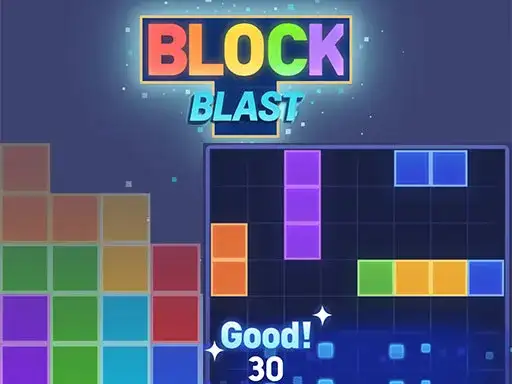
BlockBlast is a block puzzle played on a grid. Each round supplies three blocks of different shapes, and you drag each one into empty space on the board. When a row or column fills completely, it clears automatically. If a placement completes a row and a column at once, both clear together, and the game supports those combined clears where lines cross on the same move. That is the whole loop, place, clear, repeat.
The developer calls it a classic block game for all ages, easy to learn and hard to score high in. That balance is typical of the genre. The first rounds explain themselves, and the challenge arrives once the board is crowded and your three shapes no longer fit where you want them.
Placement is the only action you take. The board changes when you drop a block, so you can study the grid before each move. A careful player and a quick player can face the same arrangement. What separates results is where the shapes land.
Controls
Placement uses drag. Pick up one of the three offered blocks and drop it onto the grid in the spot you want. The block goes where you put it. On a phone or tablet, the same gesture works under a finger. On a desktop, you use a mouse drag. The developer states that each round provides three blocks of different shapes, and within that round you decide the order in which you place them.
There is no separate confirm button in the described controls. Your drag is the action. That keeps the interface simple, and it also means a slip can cost a placement. Take a second before you release the block, especially when the board is tight.
Levels and power-ups
The developer frames progression through the round and the record. Three blocks arrive, you place them, lines clear, and the score moves toward your best. The goal the developer names is breaking your record, so your own previous score is the number to beat. Combined clears are the closest thing to a bonus in the rules, a placement that finishes a row and a column at the same time recovers more empty space on the board than a single line clear does.
That recovered space is the reward, and it keeps the next three blocks playable. The board carries the consequences forward, and the next set meets whatever room you left. Treat each set of three as a small hand, since the order you use them changes the board for the following set.
If you want a way to measure progress, watch how long you keep the board open. High scores follow from survival, and survival follows from room. The developer notes that high scores are challenging, which matches the structure, the rules are simple and the board gets tighter.
Tips and strategy
Look at all three blocks before you drag the first one. In block puzzles, the three shapes form one decision, because the space you spend on the first block shapes what is possible for the second and third. Placing the largest or strangest shape early, while the grid is open, tends to leave more options. Saving an awkward shape for last often turns it into the piece that ends the run.
Protect open rectangles. A shape placed in the middle can be easy to fit now and costly later, since it may split the empty area into narrow strips that few shapes can use. Corners and edges deserve the same attention. A wide pocket gives you options that scattered single cells do not.
Do not clear every line the moment it is ready. Holding a nearly complete row for one more round can let you finish it together with a column, and crossing clears return more space. The risk is real, a held row cannot absorb odd shapes in the meantime. Decide based on the three blocks in front of you, since those are the shapes you must place.
Clear lines that are already close to complete when the finishing shape is in hand. A line that needs one small piece is cheap to finish and returns space immediately. A line that needs a long piece can wait if the board has room to absorb it.
Watch the shape of your empty space. A board with one tall column is closer to failure than a board with even coverage, because tall columns block large shapes. The run ends when none of the offered blocks fits anywhere. Keeping a mix of open areas gives each new shape a plausible home.
About this kind of game
Block puzzles give you a limited set of shapes and ask you to place them without creating gaps you cannot fill later. Once a block lands, it stays. The tension comes from limited information, you see the three shapes in front of you, and you do not know what the next round will offer. That uncertainty turns each placement into a small bet on the future.
The genre rewards planning. Reflexes help little. Good play looks like housekeeping, clearing lines in a useful order, leaving room for shapes that have not arrived, and resisting the urge to fill the most obvious gap. Beginners often pack the centre first and clear whatever looks closest to complete. That approach works for a while and then stalls when the board has no large pocket left.
The pleasure is easy to describe. A crowded board becomes open again after one well-placed shape. The frustration is the mirror image, plenty of empty cells remain, and none of them accept the block in your hand. Both feelings come from the same rule, which is that space matters, and a high count of free cells can mislead.
Where and how to play
BlockBlast runs free in the browser on desktop and mobile. There is no download to install and no account to create. The game loads only after you press the Play button, which means nothing starts in your browser or on your device until you choose to begin. That makes the page itself the entire setup.
Ads, if any appear, come from the provider’s player. They are not part of this page. On a phone with limited data, that difference is worth knowing, the page opens first, and the game files arrive when you start. GameMonetize supplies the game.
FAQ
Is BlockBlast free to play? Yes. It runs in the browser at no cost, on desktop and mobile. There is no download and no account.
Do I need to install anything? No. Open the page and press Play. The game loads after that press.
Can I play on my phone? Yes. It works in mobile browsers, and you place blocks by dragging with a finger.
How do rows and columns clear? A row or column clears automatically when it is completely filled. If a placement completes both a row and a column, both clear together.
What happens when a row and a column fill at once? Both clear together. The game supports combined clears, which returns more space than two separate clears.
How many blocks do I get at a time? The developer states that each round provides three blocks of different shapes. You drag each one into the empty space yourself.
Why did my game end? The run ends when none of the offered shapes can be placed anywhere on the board. Keeping several open areas is the usual way to delay that.
Is there a high score to beat? The developer frames the goal as breaking your record. The number to beat is your own previous best.