How to play
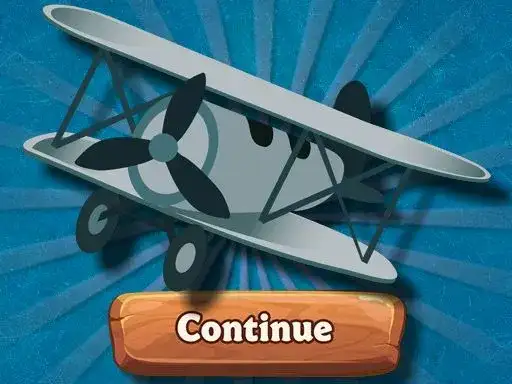
Airplane IO gives you a small aircraft, a wide map, and one simple goal. The developer states that the operation is very simple, and that all you need to do is control your airplane to move on the map. The developer also states that absorbing energy points makes you stronger and that hitting an enemy loses the game. That is the whole loop, and it suits the arcade format well.
Arcade games of this shape usually start the moment you arrive, with no lobby and no briefing. If you have played one before, the opening seconds are about reading the field and picking a direction that is not crowded. In most of them the middle of the map feels busier than the edges, simply because that is where the pickups and the traffic both tend to sit. That pattern holds across the genre more than it describes any particular map.
Size is the thing you manage. In games like this, a big aircraft can cut through contested space and a small one usually cannot. Growth rewards patience more than bravery, and the game suits players who treat each encounter as a decision rather than a reflex.
Controls
The controls are as light as they come. The developer states that you use the mouse or a tap to play. In single-pointer arcade games there is rarely a speed key, a brake, or a fire button to hunt for, which is part of why they travel so well between a laptop and a phone.
In games controlled this way, your hand position matters more than raw reaction speed. A pointer-controlled plane has to settle after every sharp change of direction, so long smooth movements usually carry you further than a series of jerky ones. Each sudden turn costs a little momentum, and that cost adds up across a run.
Keep the pointer ahead of the aircraft. Steer toward where you want to be a moment from now rather than where you are right now. If the cursor drifts to the edge of the window, recentre it before it drags your plane into a corner with no exit.
Levels and power-ups
Growth here comes from what you collect, not from a menu. The developer states that absorbing the energy points on the map makes you stronger. There is no stage list to work through and no upgrade screen to visit between attempts, which is a different rhythm from games built around numbered levels and a fixed order of play.
In arcade games of this family, the map itself often serves as the power-up system. Pickups add a little to your current run rather than unlocking named items with countdown timers. Each energy point is a small gain, and small gains stack.
So the practical question is not which stage to choose but how much you can safely collect before the field gets crowded. A cautious player often ends up stronger than a reckless one, because the reckless player stops collecting much earlier. Treat each pickup as a step and the curve becomes easier to read.
Tips and strategy
Space is the resource you are really managing. A player with room to turn has options, while a player pinned against a boundary or boxed in by larger aircraft has none. Keep at least one clear exit from wherever you are, even when the energy points are thick in the middle of a cluster.
Collect in open ground whenever you can. In games of this type the quieter edges are usually the safer place to build, and the small loss of efficiency is almost always worth it. Chasing a rich pocket deeper into the middle is the classic way to lose a good run.
Watch the aircraft larger than you. The developer states that hitting an enemy loses the game, and in this genre the biggest planes on the field have the least to fear from a collision. Give them room and let them clear space for you.
Do not chase. If an energy point sits right beside a larger aircraft, let it go. There is always more energy elsewhere, and the field is usually wide enough that patience costs you very little.
Plan a move or two ahead. The pickup you want now should not put you on a line that ends in a cluster of aircraft a second later. Reading the field as a set of routes rather than a set of dots makes a real difference.
Learn the edges. Corners and boundaries are where small aircraft die in games like this, because there is no room to turn when something large arrives. Stay a body length inside the border when you can.
About this kind of game
Games in this family are built on a single idea. You start small, you grow by collecting, and you avoid everything larger than you. They are usually played in the browser, and a single session often lasts only a few minutes, which keeps the cost of a lost run low and makes a fresh attempt easy to justify.
The tension comes from the fact that the thing you want and the thing that ends your run sit in the same place. Energy is scattered across the field, and so are the aircraft that can finish you. A player who panics and turns hard usually ends up in a worse position than a player who holds a steady line and accepts a slightly smaller haul.
Calm play usually wins. Arcade games of this kind reward steady hands as much as fast ones, and they punish a decision made in a hurry more often than a slow one.
Where and how to play
Airplane IO runs free in your browser, on desktop and on mobile. There is no download to install and no account to create before you fly. You open the page, press Play, and the game loads at that point.
If ads appear, they come from the player that serves the game rather than from us. That is worth knowing if you see a banner or a short video near the play area, because it belongs to how the game is delivered rather than to the game itself. The field, the energy points and the aircraft are the game.
On a phone, touch does the same work as the mouse. Pointer-controlled games of this kind usually ask you to hold the screen where you want the aircraft to head, then adjust as the field shifts around you. On a desktop, a mouse with a decent sensor gives finer control than a trackpad, which matters when you are threading between larger planes at speed.
A stable connection helps. A dropped frame in a busy moment can put your aircraft somewhere you did not intend, so play on a network you trust when you are chasing a long run.
FAQ
Is Airplane IO free to play? Yes. It runs free in the browser, and there is nothing to download and no account to set up.
What are the controls? The developer states that the mouse or a tap controls the aircraft.
How do I get stronger? The developer states that absorbing the energy points on the map makes you stronger.
What happens if I hit another plane? The developer states that hitting an enemy loses the game.
Can I play on a phone? Yes. The game runs on mobile as well as desktop.
Do I need to install anything? No. The game loads in the browser once you press Play.