How to play
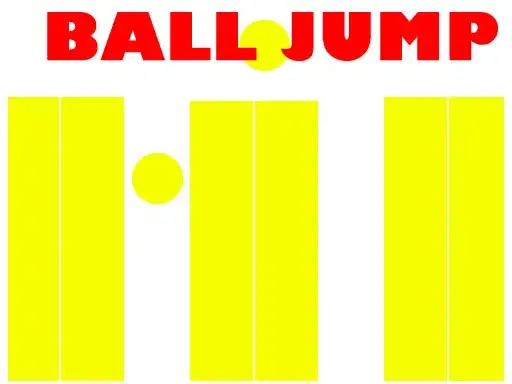
Ball Jump is a ball game in which you guide a bouncing ball along a path and keep it away from holes. The developer states that you control the ball by clicking on the screen, or by using the arrow keys to move right and left. The ball jumps as it moves, so your clicks and key presses decide where it lands. The aim is simple to state and hard to keep doing, stay out of the holes.
The developer describes the core of the game as controlling the ball. That means the challenge sits in your hands rather than in a long setup. You click, the ball responds, and you watch where it comes down. Each hole is a point where you must already have made your decision before the ball gets there.
Controls
Click on the screen to play. The developer also states that the arrow keys move the ball right and left. No other inputs are described.
The ball jumps on its own as it travels, so the controls do not tell it to leap. They only steer it. Steering early gives the ball time to come down in a safe spot, and steering late leaves you watching a landing you cannot change. The mouse and the arrow keys do the same job through different hands, and either one is a valid way to play.
Levels and power-ups
This game presents a single idea, a jumping ball, a path, and holes to avoid. The developer states that the ball will jump and that you control it. That is the whole of what is described.
A game built on one mechanic lives or dies on how quickly the next attempt begins. With no campaign structure to work through, the loop is short, start, steer, avoid a hole or fail to, and go again. For players who like a clean challenge with no clutter, that shortness is the point. The developer makes no mention of levels, unlocks, or collectibles, and none should be expected.
Tips and strategy
Watch the path ahead of the ball, not the ball itself. The ball’s jump makes it leave the ground for a moment, and during that moment the places it can safely land are already decided. Looking ahead lets you pick one of them. Small corrections early beat large corrections late, because a late correction cannot undo a jump that has already started.
The simplest habit to build is to keep the ball away from the edge of the safe ground. A ball near the middle of a safe stretch has room to move in either direction. A ball close to a hole has only one safe direction left. Keep space around the ball and you keep options. Lose that space and your next click becomes a guess rather than a choice.
Do not rush the input. Clicking once and watching the result teaches you more than clicking repeatedly in the hope that one input lands. The ball responds to what you do, so every movement is information about how far a click or a key press carries it. Learn that distance and you can plan two jumps instead of reacting to one.
Treat each attempt as a short lesson about timing. In this style of game a run tends to be brief, so the cost of a mistake is small and the information you gain is worth more than the score. One clean run tells you more about the jump than a careful reading of the controls ever will.
If the mouse feels imprecise, switch to the arrow keys, or the other way around. The developer offers both, and the better tool is the one your hands trust under pressure.
About this kind of game
Action games of this shape are built on reaction and timing. You are given a small set of moves and a hazard, and the interest comes from how narrowly you can thread the two. There is no puzzle to solve in the sense of finding a hidden answer; the answer is always the same. The question is whether you can perform it under pressure.
Readers often meet this style under the puzzle tag as well as action, and the overlap makes sense. Steering a jumping ball past holes is a planning problem as much as a reflex problem. It rewards players who think one jump ahead and punishes players who chase the ball with the cursor. Both skills can be trained. Reaction improves with short repeated attempts, and planning improves when you slow down enough to see the next safe landing.
The genre also asks for a certain tolerance for restarting. Games built on a single hazard carry little risk of losing a long campaign, because there is no long campaign to lose. A failed attempt costs seconds, not hours. Players who enjoy that rhythm tend to play in short bursts, and the format suits a browser tab that stays open while you do something else.
Where and how to play
Ball Jump runs free in the browser on desktop and mobile. There is no download and no account. The game loads only after you press Play, so nothing starts until you ask it to. Any ads you see come from the provider’s player that serves the game, not from us.
The game is made by GameMonetize. Its controls suit both a mouse and a keyboard, which means it can be played on a desktop with either input and on a touch device where a tap stands in for a click. A stable connection and a current browser are all the setup it needs. If a run goes badly, reload and press Play again.
FAQ
What is Ball Jump? A browser ball game in which you steer a jumping ball and avoid holes. The developer states that you control the ball by clicking the screen or by using the arrow keys.
How do I control the ball? Click on the screen, or use the arrow keys to move right and left. The developer describes no other controls.
Does the ball jump by itself? Yes. The developer states that the ball will jump and that your job is to control it.
Is there a download or an account? No. The game runs in your browser. No download and no sign-up are needed.
Does it work on mobile? Yes. It runs in the browser on desktop and mobile. On touch screens, tap where you would click.
Who made the game? The game is made by GameMonetize.
When does the game start? It loads only after you press Play.
Why do I see ads? Any ads come from the provider’s player that serves the game, not from us.