How to play
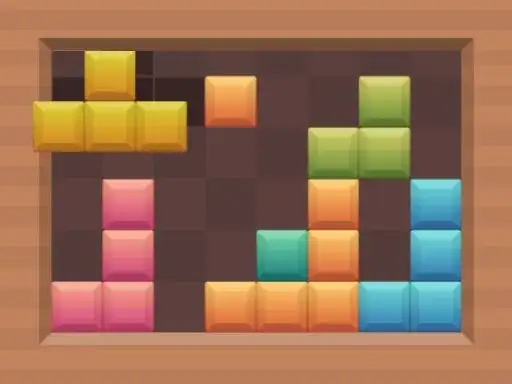
Blocks 8 is a block puzzle game in the same family as Tetris, with one important difference. The pieces do not fall on their own. You get a set of block shapes and a board, and you decide where each shape goes. The developer states the idea plainly, fill a row or column with the pieces you have available to score, and clear the board as you go. There is no timer pushing pieces down and no gravity to fight. The board only changes when you place something on it.
That single change shifts the whole feel of the game. In a falling-block game you react to whatever the game hands you at speed. Here you look at the shapes you have, look at the empty space on the board, and work out where each piece fits without wasting room. A row or column clears when it is completely filled, and that clearing is what earns points and opens space again. The developer describes the game as simple but fun and challenging. The pressure builds slowly, as the board fills up cell by cell.
Because nothing moves on its own, you can sit and think. That makes Blocks 8 a calm game on the surface and a demanding one underneath, since every placement either helps your next move or takes away a spot you needed.
Controls
The controls are drag and drop. You pick up a block piece from the area below the board and drag it onto the grid, then release it where you want it to sit. The developer’s own description of the controls says exactly this, drag and drop the block pieces below the board in a way that fills a row or column to clear the board and score points.
There are no keys to learn and no combinations to remember. A mouse works on a computer, and a finger works on a phone or tablet, because dragging is the same gesture either way. The whole interaction is one motion, from the piece tray to the cell you want to fill. You drag, you drop, and the board updates.
In this style of puzzle, a piece that cannot fit where you aim it will simply refuse to settle there. That is a useful habit to build on, because it lets you test a spot by dragging toward it and seeing whether the shape lines up with the empty cells before you let go. Take a moment to line the piece up with the grid. A placement that is one cell off can block a row you were trying to finish.
Levels and power-ups
The developer does not describe separate levels or power-ups for Blocks 8, so there is nothing of that kind to list here. What the game gives you is the board, the pieces, and the scoring that comes from clearing rows and columns. Progress in a game like this is usually measured in the score you build and in how long you can keep placing pieces before the board runs out of room.
The pieces themselves are the variety. Different shapes cover different numbers of cells and fit into different gaps, and the set you are given at any moment shapes what you can do next. A long straight piece wants an open line. A small square piece can slip into a tight corner. A blocky shape needs a wider pocket of empty cells. Reading the shapes you have and matching them to the space you have left is the core of the game.
Without a level list to work through, a run in this genre tends to end when no piece you hold can be placed anywhere on the board. That is the natural finish line. It arrives gradually, one awkward shape at a time.
Tips and strategy
Keep the middle of the board open when you can. Edges and corners are easy to fill later, but a hole in the center surrounded by placed blocks is hard to reach with most shapes. Placing toward the outside first tends to leave you more options.
Plan more than one piece ahead. Look at every shape you have been given, including the ones you are not holding yet, and check that the spot you are about to fill still leaves a home for the others. A placement that scores now but strands two shapes later is usually a bad trade.
Work toward full rows and columns. A row that is one cell short is worth nothing until that last cell is filled, and half-finished lines are where boards get stuck. When you have a choice, close a line you have already started before you open a new one.
Watch the small gaps. Single empty cells are the hardest thing to fill, because only the smallest shapes fit them. If you notice a lone hole forming, try to close it while you still have a piece that fits. Leave it too long and it becomes a permanent scar on the board.
Do not rush the last few placements. When space is tight, each drop matters more than the ones before it. A slow look at the whole board often finds a spot you missed.
About this kind of game
Block puzzle games sit between jigsaw-style fitting and line-clearing arcade play. The pieces are geometric, the board is a grid, and the goal is to keep clearing space faster than you use it up. Unlike a falling-block game, there is no speed element, so the difficulty comes entirely from the shapes you are given and the space you have left.
That makes the genre a planning exercise. Good players are not faster than everyone else. They are better at seeing which placement keeps the most doors open, and they treat empty cells as a resource to spend carefully. The tension is quiet. The board looks fine, then a few awkward shapes arrive and suddenly there is nowhere to put them.
It is also a genre that suits short sessions. A run can last a few minutes or much longer, and stopping in the middle costs nothing, since there is no timer running and no streak to protect. You can come back to the same idea later and try a different approach.
Where and how to play
Blocks 8 runs free in your browser on desktop and mobile. There is nothing to download and no account to create, so you can open the page and start playing. The game loads only after you press Play, which keeps the page light until you actually want to begin.
If ads appear, they come from the provider’s player. They are not ours. The game is supplied by GameMonetize, and any advertising around the play area is handled inside that player. On a phone, the drag controls work with touch, and on a computer they work with a mouse, so the same approach applies on either device. A larger screen makes it easier to see the whole board at once, which helps when you are planning several placements ahead.
FAQ
What kind of game is Blocks 8? It is a block puzzle game with Tetris-style pieces. You place shapes on a grid by dragging them, and you clear rows or columns by filling them completely.
How do I control the pieces? Drag a piece from below the board and drop it onto the grid. The developer states that filling a row or column clears the board and scores points.
Do the pieces fall by themselves? No. The developer notes that the logic is similar to Tetris, but you move the blocks freely by dragging and dropping them. Nothing moves unless you place it.
Are there levels or power-ups? The developer does not describe levels or power-ups for this game. You play on the board with the pieces you are given and build a score by clearing lines.
When does a run end? In this type of puzzle, a run ends when none of the pieces you hold can be placed anywhere on the board. Until then, you keep placing and clearing.
Do I need to download anything or sign up? No. The game runs free in the browser on desktop and mobile, with no download and no account, and it loads after you press Play.