How to play
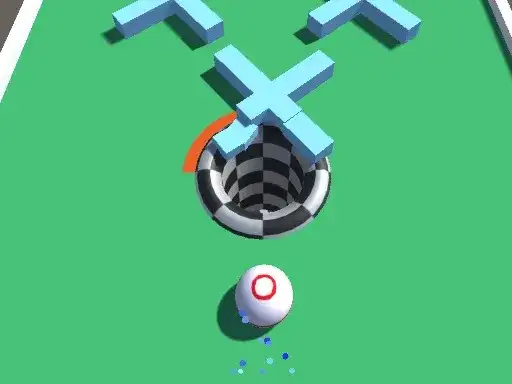
Ball.io is a casual io game built around a single job, which is to keep the ball moving toward the finish line. The developer states that you remove the obstacles in the path of the ball to reach the finish line. That is the core loop, and it frames every decision you make during a run.
A run works as a simple chain of cause and effect. An obstacle sits between the ball and the route ahead, you take it out, and the ball rolls on. The game carries ball, casual and hypercasual tags, which signals a quick pace and rules you can pick up in seconds. A round should not demand a long tutorial.
Because the goal is the finish line and the route is blocked, your attention splits between two things at once, what the ball is about to touch and what sits further along the path. Short readable rounds make it easy to try again after a mistake, and that fits the hypercasual style.
Controls
Ball.io uses the mouse. The developer states that you use the mouse to play the game. That is the whole control scheme, so there are no key combinations to memorize before your first run.
On a desktop browser that means a mouse or a trackpad. On a phone or tablet the same pointer role is filled by your finger tapping and swiping the screen. The game runs free in the browser on desktop and mobile, so the input device is the main thing that changes between platforms.
Aim before you act. Small screens reward careful taps more than fast ones, because a stray swipe can move the pointer further than you meant.
Levels and power-ups
Treat each run as a sequence of obstacles standing between the ball and the finish line. The developer describes the goal as reaching the finish line after clearing what blocks the ball, so the route ahead matters more than anything behind it. Watch what comes next rather than only the obstacle under your pointer.
General advice for this style of game is to read the whole route before you touch anything. A move that clears one blockage can open a gap that sends the ball into another. Depending on the layout, a short pause to scan the path often saves a restart.
Tips and strategy
Plan a few moves ahead. In path-clearing games the useful question is not only what you can remove now but what the ball will meet two or three steps later. If you can see the next obstacle, clear the route in an order that keeps the ball moving rather than stopping it.
Keep space open. A ball needs room to travel, so avoid crowding the path with unnecessary actions. Clear only what blocks the route and leave the rest alone until the ball actually needs it.
Work from the ball outward. Deal with the nearest obstacle first when it is about to stop the ball, then look further down the line. This keeps you from solving a problem the ball has not reached yet while it stalls at your feet.
Use short taps rather than broad sweeps. Precision matters more than speed, especially on a phone where a swipe can cover more of the screen than you intended. Small deliberate input gives you a chance to correct before the ball commits.
Accept restarts as part of the loop. Hypercasual games are built for quick retries, so a failed run costs you seconds rather than progress. After a miss, note the spot that caught you and handle it earlier next time.
Stay calm as the pace picks up. Speed tempts you into rushed clicks, and rushed clicks are how balls end up stuck. Slow is smooth here, and smooth is quick.
About this kind of game
An io game usually means a browser game with a light, instantly readable premise and short sessions. Ball.io fits that shape, a ball, a route, obstacles and a finish line. Nothing needs explaining beyond the first few seconds of play.
The casual and hypercasual labels describe design intent rather than a difficulty setting. These games aim to be understood in moments and played in short bursts. The trade-off is that depth comes from the layouts and your own timing rather than from long tutorials or complex systems.
Path-clearing mechanics reward spatial thinking. You are judging gaps, distances and order of operations with limited information, which is a puzzle skill dressed up as an action game. Players who enjoy planning a route tend to settle in faster than players who react on instinct alone.
The io format also means the game lives in a browser tab. There is no install step and no launcher, so a session can start and end in the time it takes to drink a coffee.
Where and how to play
Ball.io runs free in the browser on desktop and mobile. You do not need a download or an account to start. Open the page, press Play, and the game loads. Until you press Play, the game itself has not started loading.
If any ads appear, they come from the game’s own player rather than from this site. That distinction matters if you are troubleshooting a pop-up, because the site page itself is just the frame around the game.
On desktop a mouse gives you the most precise pointer control. On mobile the touchscreen replaces the mouse, so a finger takes over the same job. A stable connection helps, since the game loads in the browser after you press Play.
FAQ
What is Ball.io about? The developer states it is a fun and addictive io game in which you remove the obstacles in the path of the ball to reach the finish line.
How do I control the game? With the mouse. On mobile, your finger does the same work on the touchscreen.
Do I need to download anything or create an account? No. The game runs free in the browser on desktop and mobile, with no download and no account.
Does it work on phones? Yes. The game is set up for desktop and mobile browsers, with touch input standing in for the mouse.
Where do ads come from? Any ads come from the game’s own player, not from this site. They are separate from the page you open to play.
When does the game load? Only after you press Play. Before that, nothing of the game has loaded.
What is the goal of a run? To clear what blocks the ball and get it to the finish line, as the developer describes.
Is there a strategy that helps? Plan a few obstacles ahead, clear only what blocks the route, and use short precise taps instead of broad swipes.