How to play
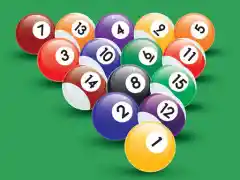
Billiard 8 Ball is a pool game that runs inside a browser window, and the developer states the goal plainly, hit all the balls into the holes and win the game. You take the cue, line up a shot, and send the balls toward the pockets set around the table. The game belongs to the sports category and carries tags such as 8 ball pool, billiard, pool, skill, and sport, which gives you a fair idea of the challenge waiting on the cloth. Each turn centers on reading the layout and choosing a useful shot across a table with a set of balls and a clear aim.
A ball sitting near a pocket is a simple target, while a tight cluster near the middle of the cloth takes more thought to break apart. The rules here are kept simple, so most of the work falls on deciding which ball to go for and how hard to strike the cue ball. Watch the positions carefully before every attempt, because a successful pot depends on both the target and the place where the cue ball stops.
Controls
You use the mouse or touch the screen, which is the whole control scheme the developer gives for this game. On a desktop, you move the pointer to set your direction and click to take the shot; on a phone or tablet, you tap and drag with a finger instead. This makes the game easy to pick up on a laptop, a phone, or a tablet, especially when you want a quick pool session without learning a complicated button layout.
Aim is the skill that matters most here, since small movements of the pointer or finger change where the cue ball travels and a steady hand counts for more than speed. Take a moment before each shot to settle on a line, and try to avoid a hurried release. A careful adjustment can change the angle enough to turn a missed pocket into a clean pot.
Levels and power-ups
The developer does not describe levels, stages, power-ups, or unlockable cues for Billiard 8 Ball. The description covers the core loop, pot the balls and clear the table to win. Read the page as a straightforward pool session that focuses on aiming, timing, and table position.
The available information presents a focused activity built around the table, the cue ball, and the pockets, giving you a compact challenge that can fit into a short sitting. Players looking for a mode list, special abilities, or upgrades to collect will find that those features are not described for this title.
Tips and strategy
Plan two shots ahead. Before you strike, look at where the cue ball will stop and whether your next target will still be reachable from there. Players who only think about the ball in front of them often leave themselves stuck behind other balls, and that is how a clean table turns into a scramble. The gap between a good player and a lucky one is usually this kind of planning, because every shot also prepares the position for the attempt that follows.
Keep the cue ball away from the rails and out of clusters whenever you can. A cue ball resting in open cloth gives you options on the next turn, while one buried in a group of balls gives you almost none. Space is the resource you manage in a game like this, with accuracy on any single shot also playing an important role. Protecting that space pays off late in a frame and gives you clearer lines when the table begins to empty.
Aim through the ball toward the pocket. The line that pots a ball runs from the cue ball through the target and on to the hole, and your cue ball has to arrive on that line. Beginners often hit the object ball squarely and then watch it stop short because the pocket was never truly on the line they chose. Check the full path before you commit, including the route the cue ball will take after contact.
Use softer shots when the target sits close to a pocket. Hard strikes send the cue ball running across the table and into trouble, sometimes scratching or leaving an easy reply. A gentle tap that drops the ball and leaves the cue ball near the middle is usually the better play. Reserve power for breaks and for shots that genuinely need it, since controlled speed gives you more influence over the next position.
Clear the easy balls first when the table is crowded. Removing balls from the cloth opens lines for later shots and shrinks the number of obstacles you have to navigate around. The table gets simpler as it empties, so the early turns are the ones that decide how hard the end will be. Save difficult angles for moments when they are necessary, and take straightforward pots while they remain available.
About this kind of game
Pool games are about geometry and restraint. Every shot is a straight line that becomes a rebound, and every hard hit is a decision you cannot take back once the cue ball is moving. That is why the best players in this genre often look slow and deliberate at the table. They check angles before they act, and watching that process can teach more than a tutorial when you are learning how position and force work together.
Angle reading is a learnable skill rather than a gift. A ball struck off a cushion leaves at roughly the angle it arrived, adjusted for spin and speed, and that basic rule covers most situations you will meet. You do not need to calculate it precisely with numbers in your head; notice it shot after shot until your eye starts to trust the pattern. Repetition is the whole method here, with each attempt giving you another chance to compare the expected path with the result.
Speed control matters as much as aim. Two shots with the same line but different force produce completely different tables, and the second one is often the one that costs you the frame. A medium stroke keeps the cue ball in the part of the table you chose, while a full-power stroke sends it wherever physics decides. Learn what your medium stroke feels like and lean on it, then add force only when the table clearly calls for a longer or stronger movement.
Patience is the third ingredient in a game like this. Rushed shots in pool games tend to be the ones that hand the table back to your opponent or leave the cue ball badly placed. If a shot does not look clean, look for another one on the cloth. There is usually a safer ball somewhere, and finding it is a skill in its own right. A slower decision can preserve your position and create a more comfortable opportunity on the following turn.
Where and how to play
Billiard 8 Ball runs free in the browser on desktop and mobile. You do not download anything and you do not create an account, so there is no sign-up form standing between you and the table. The game loads only after you press Play, which keeps the page light until you decide to start. If ads appear, they come from the player that supplies the game. This setup lets you begin from a compatible browser without installing a separate program.
That setup suits short breaks and long ones alike. You can open the page on a phone while waiting somewhere, or on a laptop between tasks, and close it when you are done. Nothing is installed and nothing is left behind on your device afterwards, so the game fits easily into a casual browser session whenever you have time for a few shots.
FAQ
Is Billiard 8 Ball free to play? Yes. The game runs in the browser at no cost, with no download and no account needed.
What do I need to play? A browser and either a mouse or a touchscreen. The developer states the controls are the mouse or touch, so both a desktop and a mobile device work.
How do I win? The developer states that you hit all the balls into the holes to win. Clear the table and the game is done.
Does it work on a phone? Yes. The game runs on mobile as well as desktop, and touch input is supported by the controls.
Are there levels or power-ups? The developer does not describe levels, stages, or power-ups for this game. Expect a straightforward pool session built around potting the balls.
Do I have to sign up? No. There is no account and no registration step. Press Play and the game loads.