How to play
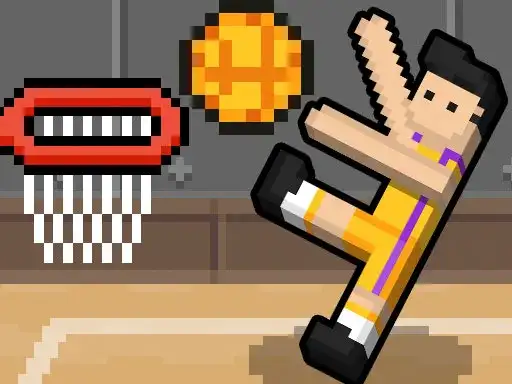
Basket Random is a basketball game built on physics and chance. The developer states that you score by using only one key, and that the fields, the players and the balls change from match to match. You can face the CPU or a friend in a two-player mode, and the developer states that the first player to reach five points wins the game. That short scoring target keeps matches tight and makes a rematch the natural next step after a loss.
The joke is in the randomness. A jump that looks perfect can send the ball somewhere strange, and a clumsy hop can drop it through the hoop. You do not aim a shot in the usual way. You time a jump and let the physics decide the rest, which turns every possession into a small gamble. The result is a match that stays close and noisy from the first tip to the last basket.
Because the rules are so short, the game suits short breaks. Start a match, play to five, and stop.
Controls
Player 1 uses the W key, and Player 2 uses the up arrow key. The developer states that you can play by touch controls on mobile devices or tablets. That is the whole control scheme.
Each key makes your player jump, and the jump is how you reach the ball, block a shot or bump your opponent. There are no separate shoot, pass or tackle buttons to remember, so a new player can be useful within a minute. On a shared keyboard, the two players sit side by side, one on W and one on the arrow key, which is cramped but workable. On a phone or tablet, the touch controls replace the keyboard, and the developer states that touch input is supported on those devices. Two people sharing one small screen will want to agree on who holds which side before the first tip.
The single input does not make the game shallow. It moves all the skill into timing and positioning, which is where the tension lives.
Levels and power-ups
The developer states that the fields, the players and the balls change between matches. Each variation shifts how the game feels, so a court that suits you in one match may work against you in the next. A ball that bounces high changes the timing of every jump, and a different player body changes how far a hop carries you.
The developer does not describe separate levels to unlock or power-ups to collect. The variety comes from the shifting court, player and ball rather than from an upgrade path. That means there is no progression screen to grind through and no inventory to manage. Every match offers a fresh setup to read.
Treat each match as its own small puzzle. Watch the first few jumps to see how the current players move and how the ball behaves, then adjust. A player who assumes every match plays the same will lose points early and spend the rest of the game catching up.
Tips and strategy
The first rule is patience. Do not jump the moment the ball appears. Wait until it is close to your player and to the hoop, then commit, because a jump that misses leaves you on the floor while your opponent is still moving. This is the most common mistake in one-key physics games, players react to the ball’s arrival rather than to the moment their body will actually meet it. A useful habit is to count the bounces after a shot and move to where the ball is heading, not to where it is now, because physics sends loose balls to predictable places more often than it first appears.
Keep your player between the ball and your own basket when you can. On a physics court, the ball often bounces back toward the middle, so a player who hangs back can collect loose balls and start the next attack. Chasing every bounce pulls you out of position and leaves the easy points open. If your opponent is already jumping, think about where the ball will land after the collision rather than where it is now.
Watch your opponent’s timing, not just the ball. If they jump early, you can wait and jump after them. If they hang back, push forward and take the space, since a court with two bodies on it rewards the player who stands where the ball will fall. Small reads like this decide most points. Many points turn on a single well-timed hop after several seconds of patient waiting.
Accept that some shots will go in for no clear reason and some will miss from a perfect position. The game is built on randomness, and fighting it wastes your attention. Play the odds and move on to the next possession, because a quick reset is worth more than a long complaint. This is general advice for physics games rather than a description of any hidden system in this one.
Use short practice runs against the CPU to learn the current court and players before you challenge a friend. The CPU gives you room to see how jumps behave without the pressure of a real opponent. Then take that knowledge into a two-player match.
About this kind of game
Physics basketball games replace precision aiming with timing and momentum. Your player is a body with weight, the ball is an object with a bounce, and the hoop is a target that does not always agree with your plan. Skill comes from reading the movement a moment ahead, and that read replaces any need to memorise a playbook. That makes the genre easy to start and hard to master, which is a good combination for a browser game.
Random variation belongs to this genre by design. Changing the court, the players and the ball keeps every match unfamiliar and stops one trick from working forever. It also means a less experienced player can win a match against a stronger one. That keeps two-player sessions lively and gives the loser a reason to ask for another game.
One-key controls suit this style because they remove the barrier of learning a control scheme. Two people can pick up the same keyboard and start within seconds. The depth comes from timing, and the skill gap shows up in decisions rather than in finger speed.
Short scoring targets, such as a race to a small number of points, keep matches tight. They also make losing streaks easier to accept, since the next match starts almost immediately and the court may already be different.
Where and how to play
Basket Random runs free in the browser on desktop and mobile. You do not need a download or an account.
The game loads only after you press Play, so nothing starts until you choose to begin. If ads appear, they come from the provider’s player and not from us.
On a computer, the keyboard controls work best, with two players sharing one keyboard for local matches. On a phone or tablet, touch controls are supported, so you can play without a keyboard. Either way, the game runs in the browser window.
FAQ
How many players can play? Two. You can play against the CPU or against a friend in the two-player mode, the developer states.
What are the controls? Player 1 uses W and Player 2 uses the up arrow key. Mobile devices and tablets use touch controls.
How do you win? The developer states that the first player to reach five points wins the game.
Does the game change between matches? Yes. The developer states that the fields, players and balls change from one match to the next.
Is there a download or account? No. The game runs free in the browser on desktop and mobile, with no download and no account.
Can I play on a phone? Yes. Touch controls are supported on mobile devices and tablets.
Are there power-ups to unlock? The developer does not describe power-ups or unlockable levels. The variation comes from the changing courts, players and balls.